Why robot learning keeps running into the data wall
A robot doesn’t just need “a lot of images.” It needs images tied to the exact action that happened, the robot’s joint positions, the scene state, and an outcome label like success, slip, collision, or near-miss. That coupling is expensive in the real world because cameras move, lighting changes, parts wear, and the robot can’t safely explore every mistake at full speed.
Even when you can collect logs continuously, the distribution is usually narrow: the same bins, the same aisle, the same backgrounds, and the same “easy” grasps operators already know work. The long tail—odd reflections, clutter, deformable objects, partial occlusions—shows up rarely, yet drives most failures.
Simulation helps, but the moment the policy relies on visual cues, small mismatches in texture, noise, motion blur, and camera calibration become performance cliffs. The result is a familiar bottleneck: more training time doesn’t fix missing coverage, and more real data often means more integration work, downtime, and safety overhead than teams planned for.
What “better images” actually change in robot training
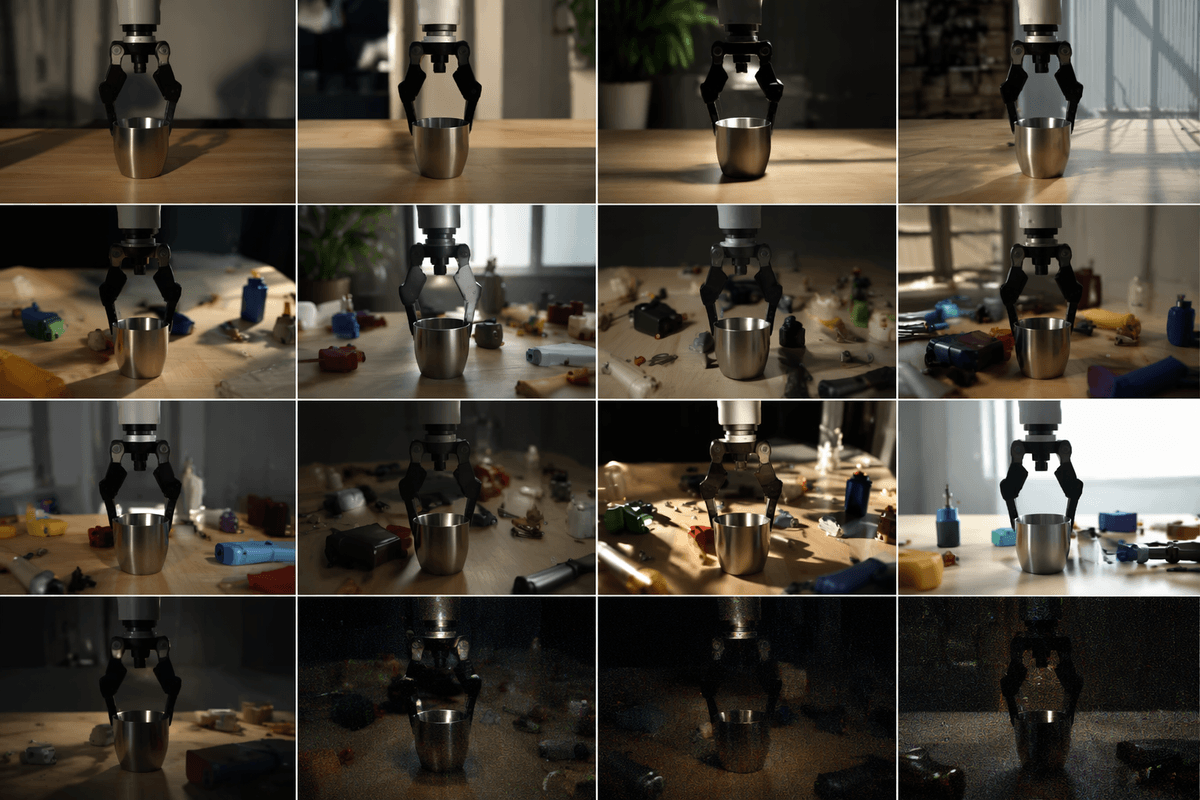
You can usually tell when a dataset is “better” because the model stops learning the background. If every successful grasp happens over the same blue tote, the network may key off tote edges instead of object boundaries, and it will look accurate in offline tests while failing on a gray bin. Generated images help when they shift what stays constant: viewpoint, lighting, clutter, specular highlights, and camera noise change, but the causal structure of the task is preserved.
That translates into two practical gains. First, perception modules get more robust features, which matters for pose estimation, segmentation, and keypoint detection feeding a controller. Second, policy learning sees more near-boundary cases—almost-collisions, partial occlusions, ambiguous grasps—so the policy becomes less brittle. The constraint is that “better” needs correct labels and geometry; photorealism without accurate poses, depths, or contact states can teach the wrong correlations and waste weeks of training.
Synthetic scenes vs. real footage: where generators fit
A familiar debate shows up fast: “Should we just generate everything?” For most teams, synthetic scenes are best treated as a coverage tool, not a replacement for real footage. Simulators and 3D scene generators excel when you need perfect labels—poses, depth, segmentation, contacts—and when you want to sweep variations that are rare or unsafe to capture, like extreme glare, odd camera angles, or near-collision trajectories. That makes them a strong fit for perception training and for stress-testing policies around known failure boundaries.
Real footage still anchors the pipeline because it carries the messiness you don’t model: sensor quirks, worn grippers, rolling shutter, vibration, and the exact texture/reflectance of your inventory. Image generators fit between these worlds by adding controlled variety to what you can already label, or by translating synthetic renders toward your camera domain. The practical constraint is cost: building assets, calibrating cameras, and validating label correctness can rival a small real-data collection campaign if you do it from scratch.
Closing the sim-to-real gap with generated variation
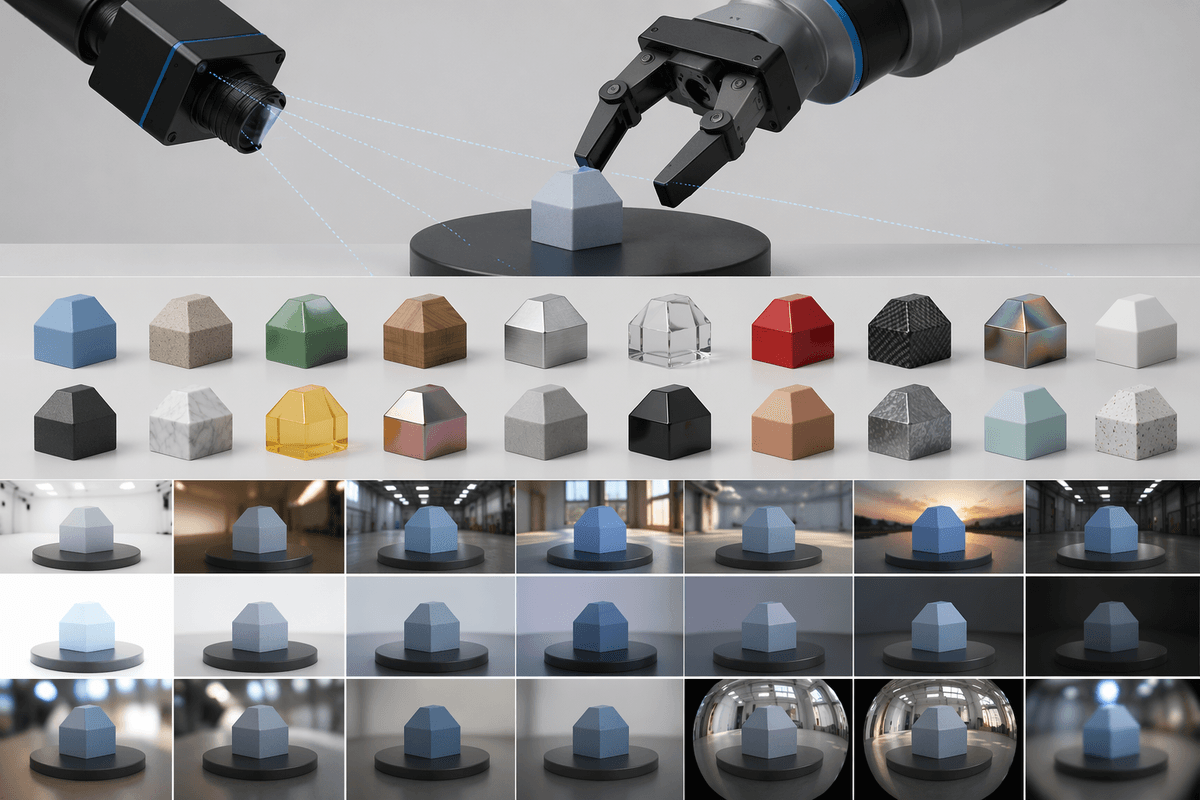
A common failure pattern is that a policy trained in sim learns to rely on “simulation tells,” like unnaturally clean edges, uniform noise, or lighting that never flickers. Generated variation works when it removes those tells and forces the model to use cues that will still exist on the real robot: shape, relative motion, contact timing, and consistent geometry between camera and gripper. In practice this looks like heavy domain randomization (textures, materials, HDR lighting, blur, exposure, camera intrinsics) plus targeted “nasties” that match your logs: specular glare on taped boxes, motion blur from fast wrist moves, or partial occlusions from cables.
Generators also help by translating synthetic renders into your camera’s visual style while keeping the simulator’s labels. That can reduce the shock when you move from perfect sim images to noisy real frames. More variation is not automatically better: randomization that breaks physics or camera calibration can teach invariances the robot shouldn’t have, and it adds a real compute and validation bill to confirm the gap actually shrank.
Data augmentation that respects robot geometry and labels
Teams often start augmentation by treating robot frames like ordinary computer-vision data: random crops, flips, color jitter, and background swaps. That can backfire because robotics labels are geometric. If you flip an image but don’t also transform camera intrinsics, 6D poses, keypoints, and grasp rectangles, you’ve created a visually plausible frame with wrong supervision. The model may still reduce loss while learning a controller that reaches consistently off-target.
Useful augmentation keeps the projective math intact. Small, calibrated viewpoint shifts, lens distortion sampled around measured intrinsics, and motion blur tied to real joint speeds preserve the relationship between pixels and end-effector motion. For segmentation and depth, you can composite occluders only if you update masks and depth ordering. For contact and success labels, you can’t “edit” them safely; you need either sim-derived labels or replayable real episodes. The practical cost is tooling: label-aware transforms and checks (e.g., reprojected pose consistency) take real engineering time.
From images to policies: common integration workflows
A typical workflow starts by training a perception model on a mix of real logs and synthetic or translated images, then freezing it as an “encoder” for downstream control. The robot learns on compact features—object pose, segmentation, keypoints, depth—rather than raw pixels, which makes policy training less sensitive to lighting and texture. In grasping, this often becomes: generate labeled renders for pose/segmentation, fine-tune on a smaller real set, then train a grasp scorer or closed-loop controller on real rollouts.
Another common pattern is to use generated images only to expand edge cases in offline evaluation: build a test suite of glare, occlusion, and clutter variants, and reject models that win on the clean set but regress on stress tests. End-to-end imitation learning from generated video exists, but it tends to be compute-heavy and fragile unless you can keep camera calibration, action timing, and labels aligned across domains.
Failure modes: when generated data makes robots worse
The familiar disappointment is a model that looks stronger offline and then gets worse on the robot. One cause is “label drift”: translated or edited images keep the pixels but quietly break the supervision—poses, masks, depths, and contact outcomes no longer match the geometry. Another is shortcut learning. If synthetic clutter has repeated patterns, or the generator adds a consistent blur or halo, the network may key off those artifacts and collapse when the real camera behaves differently.
Coverage can also become misleading. Randomizing everything sometimes washes out task-relevant cues (subtle slip, small gaps, thin edges), so the policy learns to ignore signals it needs for safe control. Teams also over-trust sim-to-real wins that come from a biased test set; if your evaluation shares the same generator quirks, you validate the artifact, not the capability. The practical fix is expensive: real-world holdouts, hardware regression tests, and label-consistency checks that catch broken geometry early.
Choosing a generator strategy and validating real-world gains
A practical way to choose a generator strategy is to start from your most expensive labels. If you need poses, depth, masks, or contact states, 3D simulation plus controlled domain randomization usually pays off first. If you already have strong sim assets but the camera look is the mismatch, translation can help—but only if you can prove labels stayed aligned. If you mainly need more backgrounds or lighting variety, label-aware augmentation is cheaper and easier to debug.
Validation should be staged and harsh: a real-world holdout with different days, operators, and lighting; a fixed on-robot regression suite; and a “no-generator” baseline trained with the same compute. Track success rate and safety metrics (collisions, near-misses), not just offline accuracy. Expect extra cost in asset work, calibration, and checks that catch label drift before it reaches the robot.