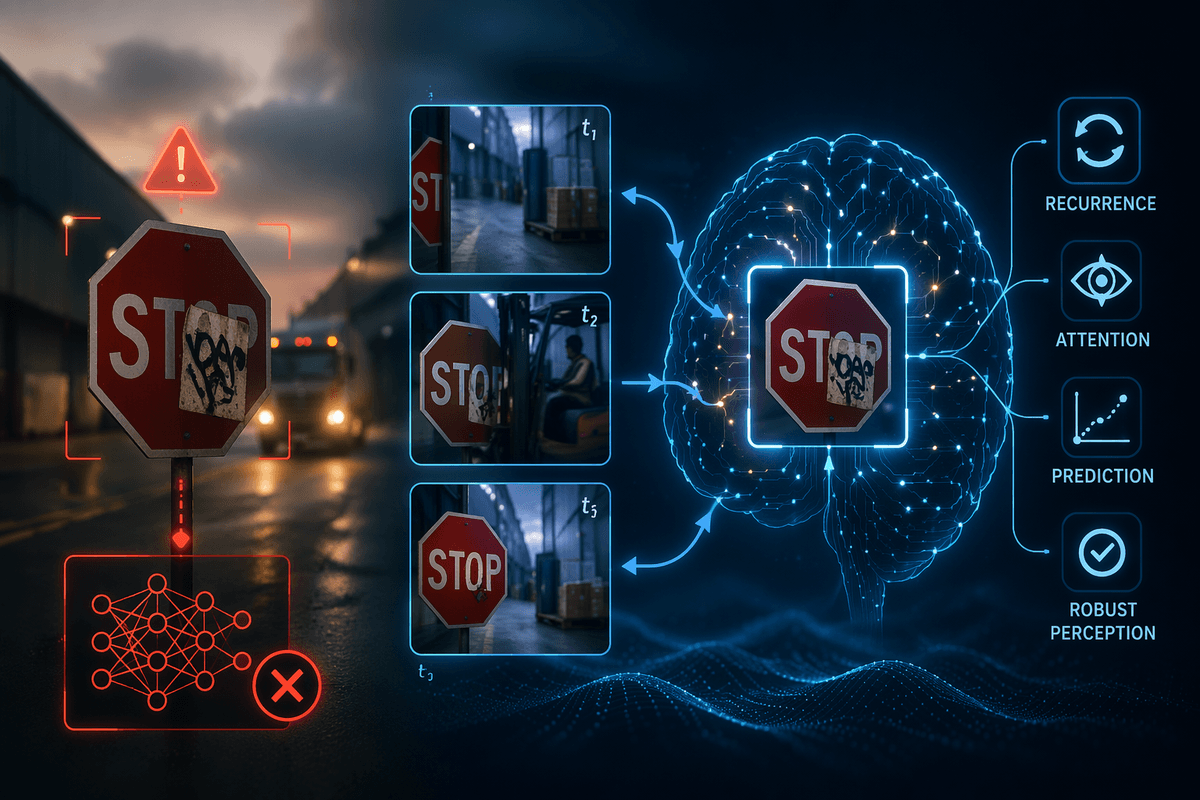
When “normal flight” stops being normal
Most automation is built around a tidy idea of “normal”: accurate sensors, expected aircraft performance, stable datalinks, and weather that stays within what the flight plan and procedures can absorb. In that envelope, an autopilot or flight management system can look highly capable because the problem stays well-posed.
Normal stops being normal when inputs stop agreeing with each other or the aircraft stops behaving like the model assumes. A pitot blockage, icing that changes drag, a drifting inertial sensor, a late runway change, or fast-moving convection can turn routine control and guidance into a time-pressured investigation.
The hard part isn’t just choosing a new action; it’s deciding whether the situation is real, which sources to trust, and what authority the automation should have. More adaptability can help, but it also raises certification burden, training cost, and the risk of surprising the crew at the worst moment.
Unexpected events that actually break autonomy in practice
In practice, the events that break autonomy are the ones that turn “follow the plan” into “prove what’s true.” A single bad sensor can be manageable; a disagreement between air data, inertial, GPS, and angle-of-attack cues can force the system to choose winners and losers in seconds. Weather is similar: turbulence and winds are routine, but embedded convection, microburst risk on approach, or icing outside forecast can invalidate performance assumptions and make nominal guidance unsafe.
System and network failures create a different failure mode: degraded flight controls, an engine-out with secondary faults, or a datalink loss that removes traffic and reroute context. Traffic conflicts and late ATC changes are especially autonomy-hostile because they combine time pressure with shared authority—an AI may optimize a maneuver that is locally “best” yet operationally unacceptable.
That is why many “adaptive” deployments start as advisory: detect anomalies, propose options, and explain why. Moving from advice to closed-loop control demands tighter limits, clearer crew roles, and evidence that the system won’t improvise beyond what operators and certification can defend.
What “adaptive” means: quick tweaks versus real learning

“Adaptive” can mean anything from a fast parameter tweak to a system that changes its own strategy. At the low end, adaptation is essentially robust control: gain scheduling, envelope protection, sensor blending, and fault-tolerant reversion modes that are pre-defined and well understood. These systems adjust within a certified playbook, and the key question is whether the “knobs” they turn are bounded tightly enough to avoid destabilizing the aircraft or confusing the crew.
At the high end, “real learning” implies the system updates a model or policy based on new data—either across a fleet over weeks, or on-aircraft in minutes. That can improve performance in shifting conditions (for example, drag changes from icing or damage), but it introduces a verification problem: you must show not only that today’s behavior is safe, but that the update process cannot drift into unsafe regions.
For decision-makers, a practical discriminator is whether adaptation changes only numerical parameters inside fixed logic, or can create new rules. The latter generally drives heavier oversight, data management cost, and clearer constraints on when learning is allowed at all.
Detect, diagnose, decide: the response loop under time pressure
A crew recognizes the pattern: something feels “off,” but the first job is narrowing down whether it’s a real aircraft state change, a sensor lie, or a procedure mismatch. An adaptive AI faces the same sequence, but at machine speed: detect a deviation, diagnose likely causes, then decide on a response that remains flyable, legal, and understandable. The timing matters because the most dangerous window is often the minutes when the system is still figuring out which data to trust.
Detection is usually statistical—values disagree, trends look wrong, or the aircraft response no longer matches expected dynamics. Diagnosis is the hard part, because multiple faults can explain the same symptoms, and “most likely” is not the same as “safe to act on.” A good design carries uncertainty forward explicitly: it can say “pitot blocked” and also “I’m only 60% confident,” then choose actions that are safe across those possibilities.
Decision is where autonomy can create new risk. Advising a checklist is different from trimming thrust, changing flight path, or negotiating a reroute. Under time pressure, the system must prioritize stability and crew alignment over optimization, and it must pay a real cost: more computation, more sensors to cross-check, and more pilot training to calibrate trust when recommendations change quickly.
Keeping adaptation safe with guardrails and invariants
The moment an adaptive system is allowed to “try something,” it needs hard boundaries that keep experimentation out of the flight path. In practice, that means invariants: limits that must remain true regardless of what the model believes. Common examples are attitude, load factor, airspeed/Mach, angle-of-attack margins, bank limits near the ground, and protected energy states on approach. If adaptation is tuning control gains or blending sensors, it should be confined to certified ranges with stability margins that remain valid even under worst-case uncertainty.
Guardrails also apply to authority and explainability. A system can be required to degrade gracefully: if confidence drops, revert to a conservative mode, freeze learning, or fall back to a known-good controller and checklist-style advisories. The crew should see what assumption changed and which constraint is binding, not just a new command. The tighter bounds can blunt performance benefits, and building monitors that catch “almost unstable” behavior adds complexity, test burden, and new failure cases of its own.
A useful operating rule is simple: allow adaptation only where you can prove bounded behavior, and treat anything that changes rules—rather than parameters—as a separate, higher-certification function with explicit on/off conditions.
Testing the rare stuff: simulation, scenarios, and flight trials

Rare events are exactly where adaptive logic earns its keep, and exactly where traditional test programs run out of examples. The practical workaround is to treat simulation as the primary evidence generator: high-fidelity aircraft and sensor models, injected faults, and weather/traffic scenarios that stress the detect–diagnose–decide loop. The goal isn’t pretty trajectories; it’s proving the system stays inside invariants while uncertainty is high and inputs disagree.
Scenario design matters more than sheer volume. Teams need “combinatorial” cases—icing plus pitot issues, GPS degradation plus reroutes, turbulence plus control-surface limits—because real incidents rarely arrive one at a time. It also helps to test human interaction explicitly: delayed pilot acknowledgment, mode confusion, and contradictory ATC constraints.
Flight trials then serve as a calibration step, not the main search for edge cases. They validate model fidelity, sensor behavior, and crew procedures under bounded conditions, but they are expensive, time-limited, and ethically constrained from recreating the most dangerous corners.
A practical checklist for choosing an adaptive architecture
A decision team usually isn’t choosing “AI or not,” but where adaptation is allowed to live: advisory, limited closed-loop control, or a broader re-planning authority. Start by listing the top three autonomy-breakers in your operation (for example, air-data disagreement in icing, convection-driven reroutes, or engine-out with secondary degradations) and require a traceable story for each: what it detects, what it assumes, what it will never do.
Then pressure-test the guardrails. Ask which invariants are enforced independently of the adaptive element, what triggers reversion, and what the crew sees when confidence drops. Demand evidence tied to scenarios you care about: combinatorial tests, human-in-the-loop results, and a plan for software change control. Budget for the unglamorous costs—monitoring, data curation, training, and recurring certification effort—because these often decide whether “adaptive” is deployable.