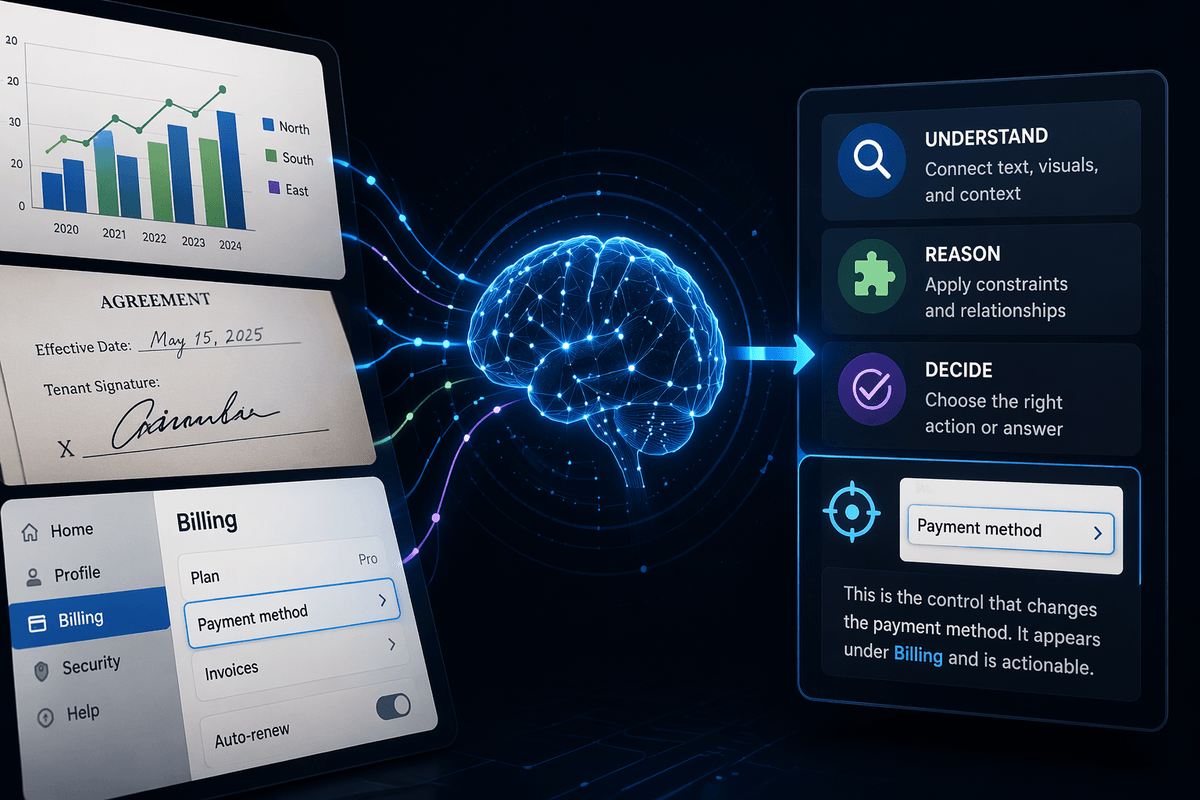
From search to synthesis: why research workflows are changing
Most research teams still start with search: keywords, filters, a stack of PDFs, and a growing sense that the hard part isn’t finding information—it’s connecting it. The volume of papers, preprints, protocols, and internal notes keeps rising, while timelines and expectations for “evidence-backed” decisions keep shrinking.
That pressure shifts workflows from retrieval to synthesis. Instead of reading everything end-to-end, people triage, extract claims, compare methods, track definitions, and map gaps. Generative AI fits here because it can draft structured summaries, cluster themes, and translate across jargon, helping you move from “what exists” to “what it means” faster.
AI can misstate findings, flatten nuance, or miss key exclusions, and validating outputs adds time and process overhead. The real change is not replacing judgment, but reallocating effort toward checking, documenting, and reusing synthesized knowledge.
Where generative AI already fits in the research lifecycle
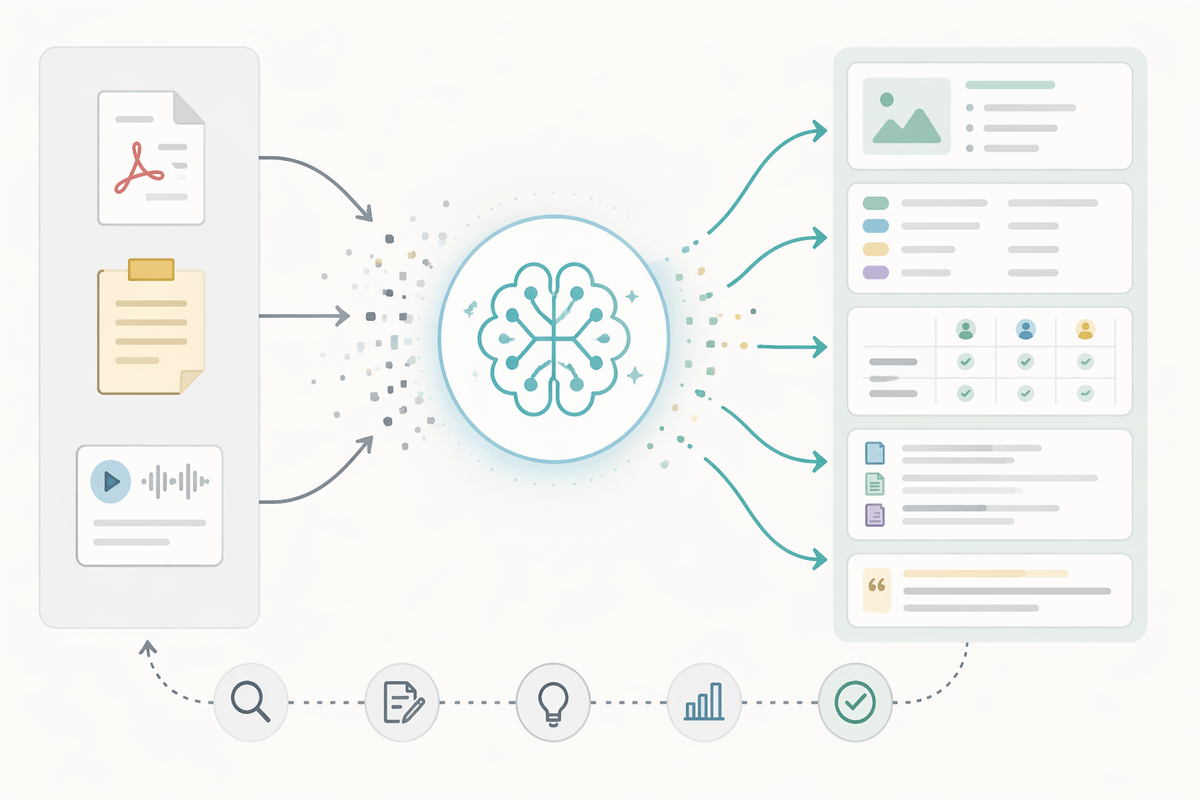
A familiar moment: you have three hours before a project meeting, ten “must-read” papers, and a decision that depends on what the evidence actually says. Generative AI is already useful in that gap between raw sources and a usable brief. It can turn PDFs, notes, and transcripts into consistent summaries, pull out key variables and assumptions, propose a comparison table across studies, and draft the first pass of an annotated bibliography—work that is repetitive, but still mentally taxing when done at speed.
It also fits in “small glue” tasks that slow research down: translating technical sections into plainer language for stakeholders, generating search strings and inclusion criteria drafts, writing code skeletons for data cleaning, or suggesting exploratory plots and questions to ask of a dataset. Every output needs a trace back to sources, because plausible-looking errors and unspoken bias are common, and sensitive or proprietary inputs may not be safe to upload without a clear data-handling policy.
Literature review at scale: faster discovery without losing rigor
You can feel the pain point when a literature review stops being “read the core papers” and becomes “monitor a moving field.” AI helps by widening the first pass: skimming dozens of abstracts, flagging likely methods or populations, and grouping papers by outcome measures or definitions so you can see where studies are actually comparable. Done well, that speeds up discovery while keeping the review anchored in explicit criteria.
Rigor comes from how you use it. Treat model output as a draft extraction sheet, not a verdict: require quoted evidence snippets with page or section pointers, and keep a standing list of fields you always extract (design, sample, intervention, controls, endpoints, limitations). Then spot-check a fixed percentage of papers end-to-end, especially anything that will be cited in recommendations.
You’ll spend time building prompts, templates, and a tagging scheme that your team agrees on, and you’ll still hit OCR errors, paywalled PDFs, and ambiguous reporting that no model can resolve without human judgment.
Turning messy sources into structured data you can analyze

A familiar bottleneck appears once you move beyond papers: lab notebooks, instrument logs, interview transcripts, vendor datasheets, and email threads all contain “data,” but not in a form you can sort, filter, or compare. Generative AI can help you turn that mess into a consistent schema: extract entities (materials, conditions, sample IDs), normalize units, tag outcomes, and map free text to controlled terms. The result is a table you can audit, join with other datasets, and visualize—without manually copying every line.
The practical approach is to start with a narrow extraction template and enforce it. Define fields, allowable values, and confidence flags, then have the model produce both the structured row and the supporting snippet it came from. You still need human checks, because OCR noise, inconsistent terminology, and implicit context (“room temperature,” “standard protocol”) create silent errors. There’s also a real cost: building a usable schema takes time, and running large batches can be expensive and constrained by privacy rules around sensitive notes or patient-adjacent text.
Idea generation, hypothesis refinement, and experimental planning
You see it when the team agrees on the problem but not the next move: too many plausible mechanisms, too many variables, and not enough time to explore them all. Generative AI can act as a structured brainstorming partner by producing a menu of candidate hypotheses tied to specific assumptions (“if X is true, Y should change”), plausible confounders, and the kinds of observations that would actually discriminate between explanations. The useful output is not novelty; it’s coverage—surfacing options you might skip under time pressure.
Hypothesis refinement gets better when you force specificity. Ask for testable predictions, boundary conditions, and alternative hypotheses, then require a brief rationale anchored to your own priors or extracted literature claims. For experimental planning, models can draft a factor table, propose negative and positive controls, suggest measurement checkpoints, and generate a preregistration-style outline so decisions are explicit before results are known. The models won’t know feasibility constraints (instrument time, recruitment rates, reagent stability), so plans still need local review, cost checks, and a decision log you can defend later.
Choosing tools: chatbots, RAG systems, and fine-tuned models
You can usually tell which tool you need by noticing what’s failing: is the model “smart enough” but unaware of your sources, or is it seeing the sources but using them inconsistently? A general chatbot is the quickest to adopt for drafting, reframing questions, generating checklists, and getting unstuck on code or analysis plans. The catch is that it has no reliable access to your internal PDFs, prior decisions, or lab conventions, so it will confidently fill gaps unless you supply context and demand citations.
When the task depends on your own corpus—SOPs, past reports, a curated library—a retrieval-augmented generation (RAG) setup is usually the better default. It grounds outputs in documents you control and can return passages to audit, which helps with reproducibility and reduces accidental invention. The practical constraint is engineering and upkeep: chunking and metadata choices matter, access control is nontrivial, and retrieval quality degrades if documents are messy or poorly tagged.
Fine-tuning is worth considering only when you need consistent behavior at scale: a stable extraction format, a specific writing voice for templates, or classification aligned to your lab’s taxonomy. It won’t “teach” the model new facts as reliably as people expect, and it adds cost, evaluation work, and governance around training data and drift.
Guardrails that make AI research outputs trustworthy and reusable
A common failure mode is a clean-sounding summary that can’t be traced. Make traceability a default: require claim-level citations, page/section pointers for PDFs, and short supporting excerpts for any number, effect direction, or exclusion rationale. Pair that with a lightweight evaluation habit: spot-check a fixed slice of outputs, and increase scrutiny for anything that will influence funding, safety, or external communication.
Reusability comes from standardization. Use shared extraction templates, controlled vocabularies, and confidence flags (“verbatim,” “inferred,” “unclear”) so downstream analysts can filter rather than reinterpret. Log prompts, model/version, retrieval set, and post-edits in the same place you store the resulting table or memo; otherwise the work can’t be reproduced when the model changes.
Data handling is the other guardrail. Decide upfront what can be uploaded, what must stay in a secured RAG environment, and what needs redaction. Expect costs: tighter controls, dual-review, and documentation slow the first few projects, but they prevent un-auditable outputs from becoming “institutional knowledge.”
A practical first month plan for adopting AI in research
A workable first month starts with one workflow you already repeat: weekly literature triage, interview coding, or cleaning instrument logs. In week 1, write a one-page “definition of done” for that workflow (fields to extract, required citations/snippets, privacy rules, and who signs off). In week 2, build a shared prompt and output template, then run it on a small, known set and measure error types, not just speed.
In week 3, move to a larger batch with fixed spot-check rates (for example, 10–20% plus every high-impact item), and log prompts, model/version, retrieval set, and edits alongside outputs. In week 4, decide whether to stay with a chatbot, invest in RAG, or stop the use case entirely. Plan for friction: access control, redaction, and review time can erase gains if you scale too fast.