Why “AI diversity” is becoming a collaboration advantage
A familiar pattern is showing up in teams adopting AI: the first “win” comes from one good assistant, and the next plateau arrives when everyone relies on the same assistant in the same way. Outputs start to converge, critique gets weaker, and people stop noticing what the tool consistently misses. “AI diversity” is a response to that plateau—using more than one model, tool, or configured agent so a team can get different angles on the same work.
The advantage is practical, not philosophical. One AI might excel at fast drafts, another at risk spotting, another at structured planning, and another at translating between functions like product, legal, and engineering. When those perspectives are intentionally compared, teams surface assumptions earlier, reduce groupthink, and make decisions with clearer trade-offs.
Multiple AIs can introduce inconsistent tone, conflicting recommendations, and “analysis sprawl” if the team treats every output as equally valid. The collaboration edge appears only when you pair diversity with a shared workflow: who asks what, how disagreements are resolved, and what evidence beats a convincing answer.
What AI diversity actually means inside a team
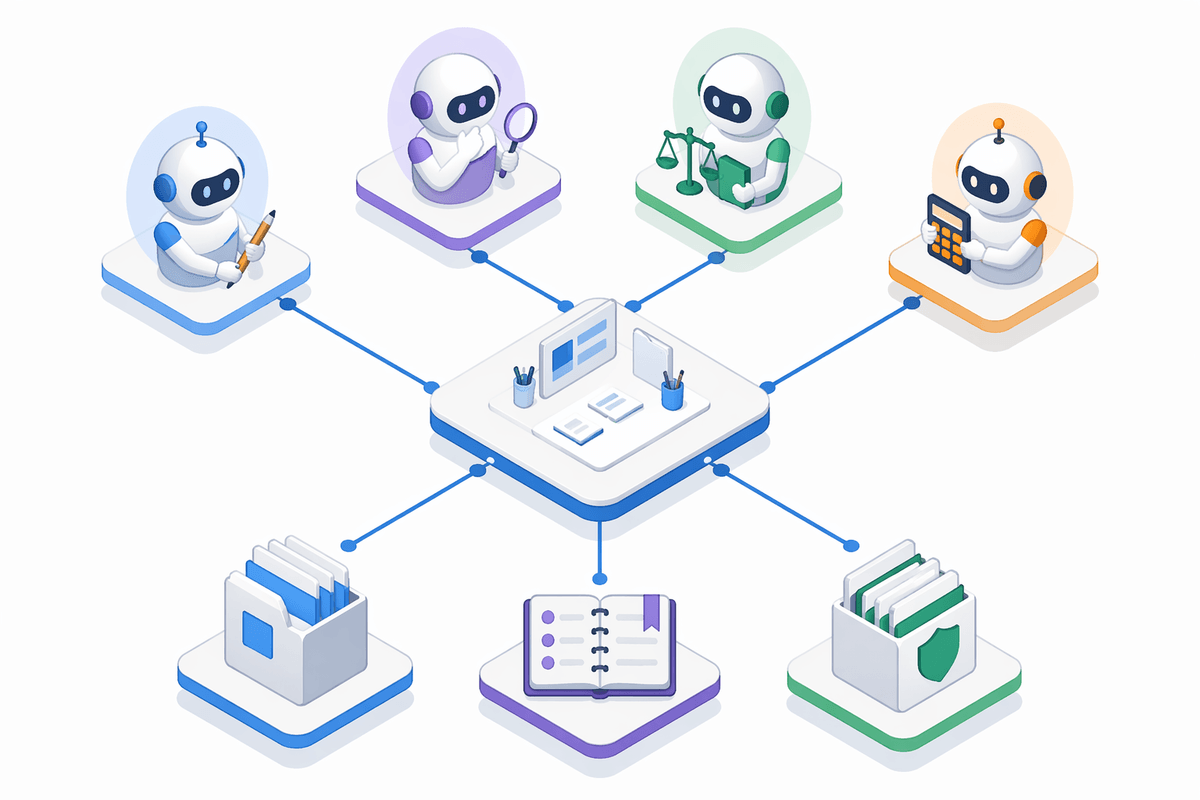
A common misconception is that “AI diversity” means letting everyone pick any tool and calling it innovation. Inside a team, it’s more specific: deliberately using different AI roles to create productive disagreement, then reconciling it through a consistent process. Diversity can come from different foundation models, different vendors, or the same model configured into distinct agents (for example: a drafter, a critic, a fact-checker, and a stakeholder translator).
It also includes “prompt diversity,” where two people ask the same question with different constraints (time horizon, target customer, compliance posture) and compare what changes. The goal isn’t more output; it’s better coverage. The constraint is that diversity needs a shared rubric—what counts as evidence, what format decisions must land in, and when the team stops iterating—otherwise you get noise, not insight.
Common collaboration breakdowns AI can either fix or worsen

Picture a planning meeting where the loudest voice sets the frame, and everyone else edits around it. One AI can help by quickly producing options, making trade-offs explicit, and giving the group a neutral draft to react to. The same AI can also worsen the dynamic if the draft becomes “the answer,” with people deferring to its confidence and stopping early.
Another common breakdown is translation debt: product writes in outcomes, engineering responds in constraints, legal responds in risk, and the thread turns into parallel monologues. Role-based agents can bridge this by rewriting the same decision in each function’s language and identifying where requirements conflict. The risk is inconsistency—different tools may interpret terms like “MVP,” “must,” or “approved” differently unless you standardize definitions and decision templates.
Finally, AI can either reduce or amplify meeting fatigue. It can summarize, track owners, and flag unresolved questions, but multiple AIs can create “too many answers” unless you limit who generates final recommendations and require sources or assumptions for any strong claim.
How multiple AI perspectives improve decisions and reduce blind spots
A recognizable moment in decision-making is when a plan sounds clean, but it’s clean because key constraints never entered the conversation. Multiple AI perspectives help by forcing the work through different lenses before the team commits: one agent drafts a recommendation, another tries to break it, a third checks for missing stakeholders, and a fourth rewrites the decision in measurable terms. When those outputs disagree, the disagreement is often the point—it reveals hidden assumptions about timelines, users, costs, or what “success” actually means.
This is especially useful in cross-functional calls where people share vocabulary but not definitions. A “risk spotter” agent will flag edge cases and compliance triggers that a “product optimizer” agent ignores, while an “engineering estimator” agent will surface dependency chains that don’t appear in a roadmap-friendly narrative. Running several passes can slow decisions, so teams need a rule like “two perspectives for low-stakes work, four for irreversible bets,” plus a simple rubric for choosing which critique is actionable.
Making quieter voices louder with inclusive AI workflows
You can usually tell a team has a “voice imbalance” when the same two people define the problem, and everyone else only reacts to wording. Inclusive AI workflows help when they make contribution easier than interruption. A practical example is an “async first pass”: each person drops a short note (constraints, risks, customer insight), and an AI consolidator produces a neutral option set that preserves attribution (“ops concern,” “support signal,” “design assumption”) instead of blending everything into one confident paragraph.
Another reliable pattern is that quieter voices often carry edge cases—implementation pain, policy friction, user complaints—that arrive late. Give those perspectives an explicit slot by using role prompts that represent under-heard functions (support, accessibility, QA, finance) and requiring the group to answer their questions before approval.
Tool stack choices: standardize enough, diversify enough
Teams feel the pull between “everyone use the same tool” and “let people work their own way.” Total standardization makes collaboration smoother, but it also recreates the single-assistant plateau: same defaults, same blind spots, same tone. Total freedom creates review friction—outputs arrive in different formats, with different assumptions, and it becomes unclear what’s authoritative.
A workable pattern is to standardize the interfaces and artifacts, not the entire toolchain. Pick one shared workspace for prompts, decisions, and summaries; one template for recommendations (assumptions, options, trade-offs, risks, sources); and one place where “final” versions live. Then allow a small, intentional set of models or agents for distinct roles: drafter, critic, risk/legal lens, and estimator. You’ll need lightweight evaluation (spot-checks, red-team prompts, and a change log) so swaps in models or settings don’t silently change team behavior.
Guardrails: preventing bias, confusion, and ‘too many answers’
The first failure mode with multiple AIs is treating every response as a vote. Set a rule that outputs are inputs, and decisions must land in one shared template: assumptions, options, trade-offs, risks, and what would change your mind. Require each agent to label confidence, note missing data, and separate “recommendation” from “reasoning,” so persuasive wording doesn’t beat better evidence.
Bias guardrails work best when they’re operational. Maintain a short glossary for loaded terms (like “must,” “approved,” “compliant,” “high risk”), and run a standard “counterexample” prompt on high-impact decisions: who is excluded, what harms are plausible, what constraints were assumed. Pair that with human spot-checks on sensitive areas (HR, legal, safety) because tools can mirror biased inputs or outdated policies.
To prevent “too many answers,” cap perspectives: one drafter, one critic, one domain lens. If outputs conflict, assign an owner to reconcile and cite sources; if no sources exist, treat it as a hypothesis and timebox follow-up.
A simple rollout plan and what to measure
A simple rollout is a two-week pilot on one recurring workflow (spec review, sprint planning, customer escalation). Define three roles: drafter, critic, domain lens, and require all outputs to land in the same decision template with assumptions and sources. Pick one owner to reconcile conflicts and publish the “final” artifact; everyone else treats AI output as input. Keep the tool set small at first, then add one new model or agent only after the workflow is stable.
Measure adoption and quality, not volume: cycle time to decision, number of reopened decisions, defects or rework tied to missed constraints, and whether risks are flagged earlier. Track disagreement rate between agents and humans, plus resolution time, to spot “analysis sprawl.” Add a lightweight monthly audit on sensitive areas (legal/HR/safety) and log any prompt or model changes that shift recommendations.