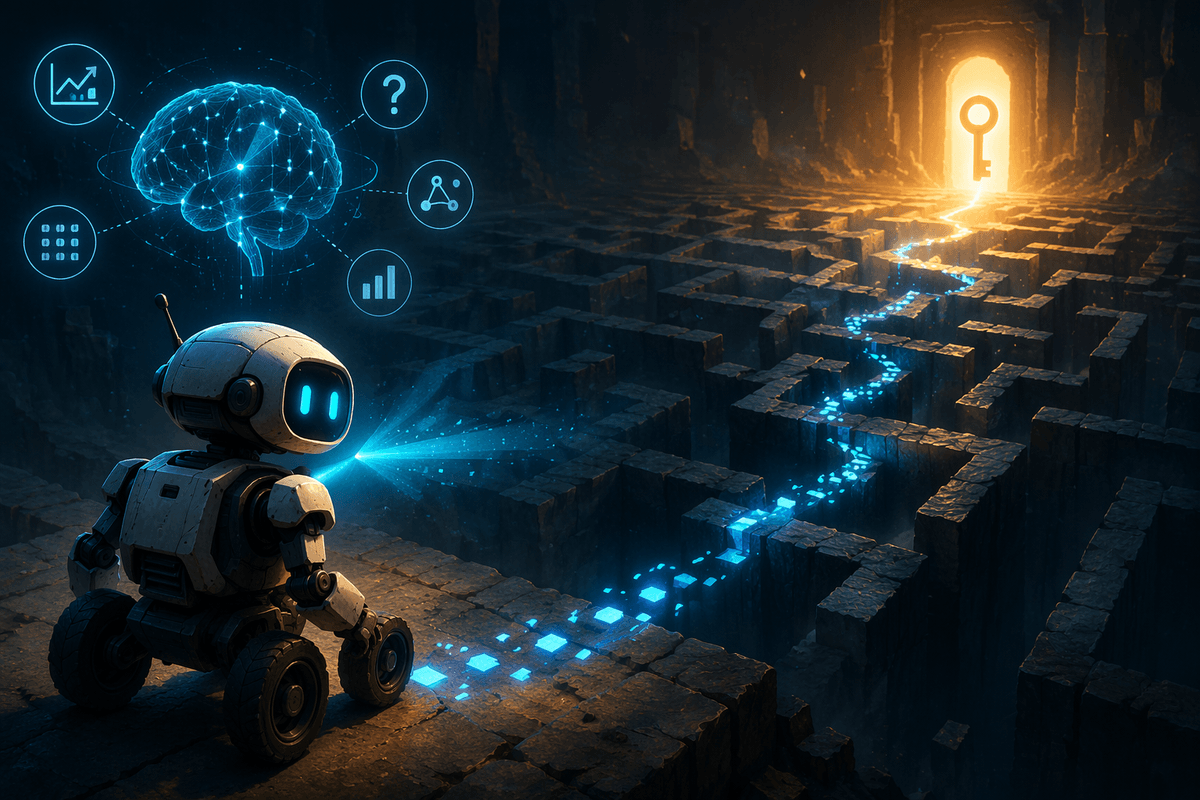
If you want to understand how a prompt becomes a picture, you have to kill the idea that the machine "imagines" anything. There is no creative "spark." What you have is a massive, industrial-scale pattern matcher that has been trained to find order in chaos. When you type a prompt, the machine isn't looking for a "vibe"; it’s translating your words into a coordinate on a massive mathematical map.
The actual work happens through a process called Iterative Denoising. Imagine you have a canvas covered in pure digital static—like a TV with no signal. The machine uses your prompt as a compass to navigate that noise. It asks itself: "Which of these random pixels, if nudged slightly, look more like a red apple?" It mathematically "sculpts" the noise, removing the bits that don't fit the pattern, until a coherent image emerges. It’s not drawing; it’s unmasking a statistical probability.
The Pre-History: The Failed Experiments (1970s–2014)
Most people think this tech started in 2022, but the struggle to automate vision goes back decades. In the 70s and 80s, researchers tried to use "Symbolic Logic." They tried to write down the mathematical rules for what a "face" looked like. It was a disaster. You can’t write enough rules to describe the way light hits a human cheek. These systems were "brittle"—they worked in the lab and broke the second they saw a real photo.
The first "Big Bang" was in 2014 when Ian Goodfellow invented GANs (Generative Adversarial Networks). A GAN worked like a duel between two programs: one (the Generator) tried to create a fake image, and the other (the Discriminator) tried to catch it. If the Discriminator caught the fake, the Generator had to try again. It was a massive leap forward, but GANs were incredibly unstable.
The Bridge: Turning Language into Math (CLIP)
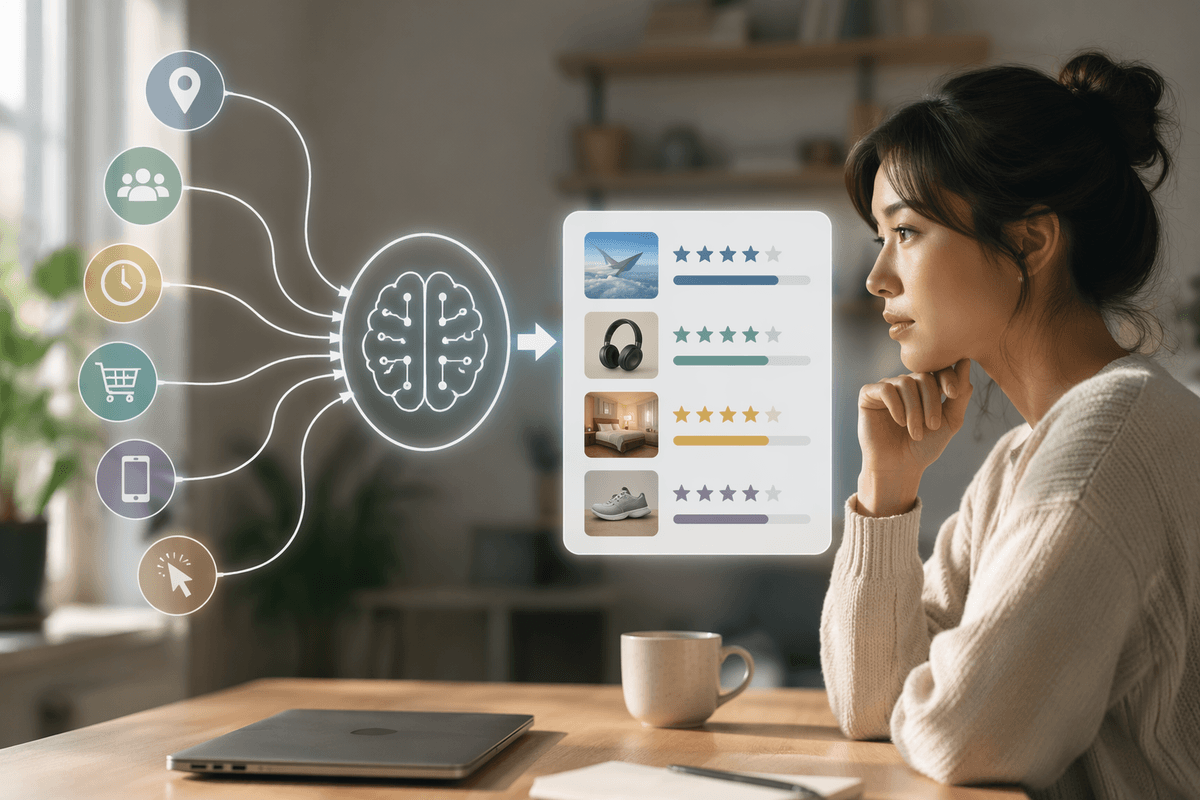
The biggest hurdle in this tech is getting the "math" of words to talk to the "math" of pixels. This is handled by a system called CLIP (Contrastive Language-Image Pretraining). Think of CLIP as a bilingual dictionary that was trained by looking at billions of images and their captions from the internet.
When you type "a red apple," CLIP turns that phrase into a Vector—a string of numbers that represents "redness" and "appleness." The image generator then looks for visual patterns that sit at those same numerical coordinates.
The friction here is that if your language is too complex, the "translation" breaks. This is why you get "attribute leakage"—where you ask for a "red apple and a blue bowl" and end up with a blue apple. The math gets the colors mixed up because the "vectors" for the two objects are overlapping in the machine's head.
Latent Space and the Efficiency Jackpot
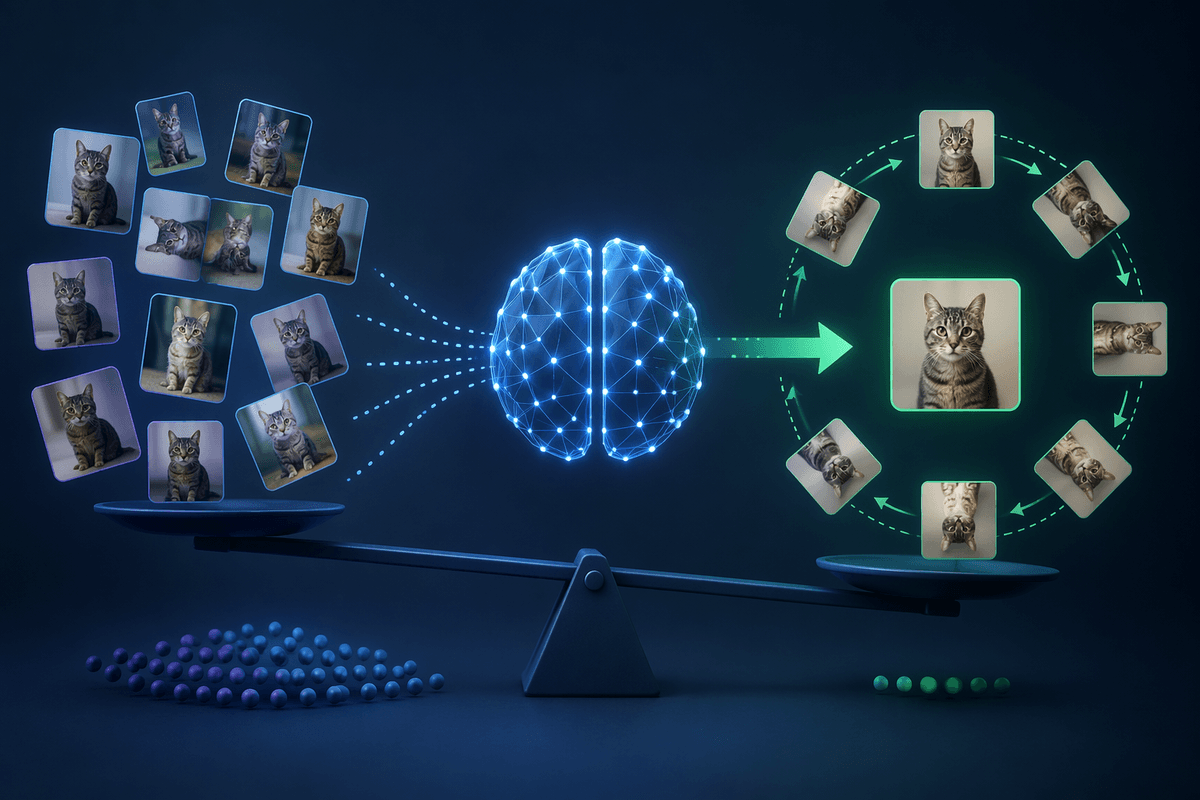
Generating a high-res image pixel by pixel is incredibly "heavy" on hardware. If the machine had to calculate every single pixel from scratch, your computer would melt. To solve this, most modern systems work in Latent Space.
Instead of working with the raw, heavy image, the machine works with a "shorthand" version. It’s like a blurred-out, mathematical sketch that contains all the important info (shapes, colors, textures) but uses much less data. Only at the very last step does a second model—called a VAE (Variational Autoencoder)—turn that mathematical sketch back into a crisp, high-res photo.
This is what allows you to generate a 4K image in seconds on a standard GPU. It’s a trick of compression that makes the "magic" fast enough to be useful in a professional office. Without Latent Space, this tech would still be a slow, expensive experiment in a university lab.
The "Production Speed" Reality in 2025
In the professional world, this tech isn't about making "art"; it’s about Reducing Latency. In industries like advertising or product design, the "Idea-to-Visual" gap used to be weeks. You’d have a meeting, a designer would sketch some options, you’d give feedback, they’d redraw.
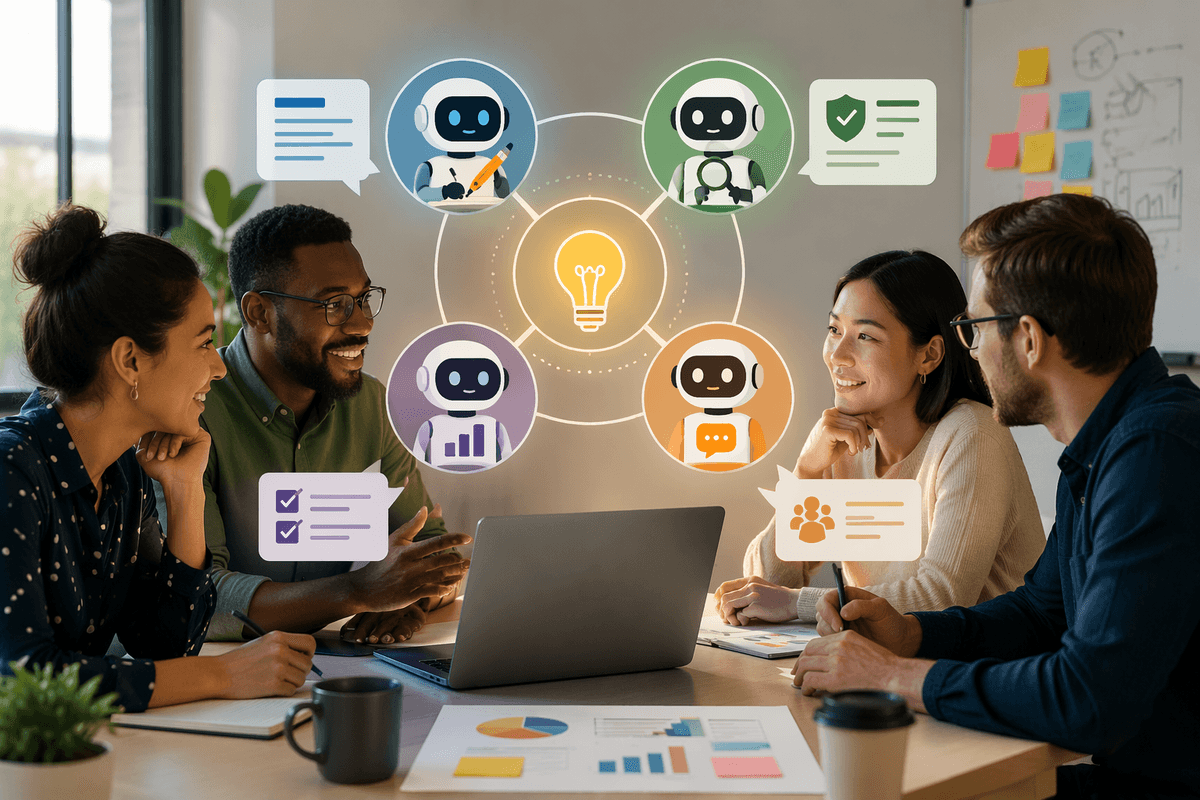
Now, a manager can sit in a meeting and generate fifty "Visual Concept" options in ten minutes. According to industry data, companies using these synthesis tools are seeing a 40-60% reduction in production costs. It doesn't replace the final high-end design, but it kills the "blank page" problem. It allows for Rapid Prototyping at a scale that was physically impossible two years ago. You aren't paying for the machine to be an artist; you're paying for the machine to be a high-speed drafting table that lets you "fail fast."
The Friction: The "Truth" and "Control" Gap
As powerful as this is, the transition is a grind for two reasons: Control and Fidelity.
The Control Problem: Most generators are "black boxes." If the machine gives you a perfect image but the character's hair is the wrong color, you can't just "fix it" easily. In 2025, professionals are moving toward ControlNet—tools that let you feed a basic sketch or a pose into the machine to "force" it to follow a specific structure. You’re no longer just typing; you’re providing a skeletal frame for the machine to build on.
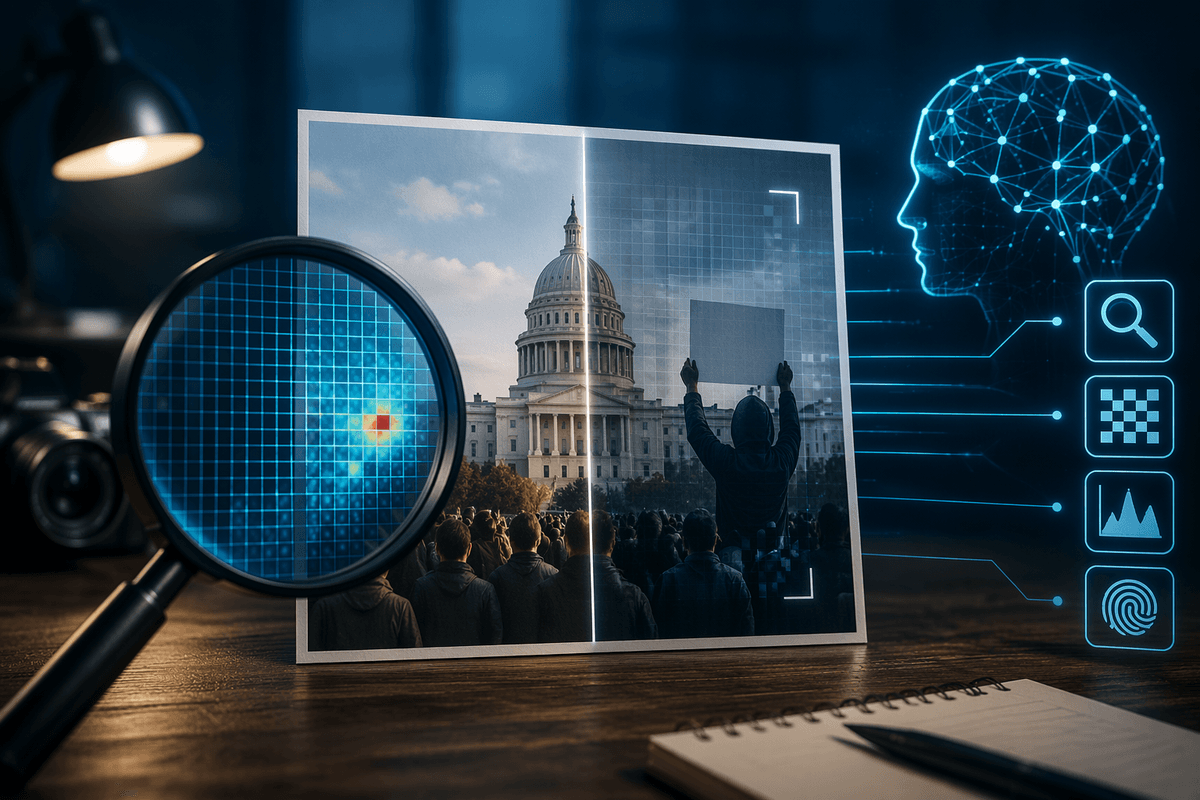
The Fidelity Problem: Machines still struggle with structural logic. They don't know that a bicycle needs a chain to work or that a human hand only has five fingers. They are "hallucinating" the look of a bike, not the mechanics of one. For technical industries like architecture or engineering, this is a massive liability. You can't use a generated blueprint for a bridge if the machine doesn't understand gravity.
The Legal "Copyright Wall" of 2025
The final reason this matters is the Ownership Gap. By late 2025, the legal world has hit a hard wall. In many jurisdictions, you generally cannot copyright an image created entirely by a machine. This means for high-stakes branding, you can't just "hit generate" and walk away. If you use a generated logo, a competitor could technically copy it, and you’d have zero legal standing.
This is why companies are shifting toward Custom-Trained Models. They are building private engines trained only on their own past assets and licensed stock. It’s about "Commercial Safety." They need to prove that the machine isn't "leaking" the style of a specific artist or a competitor’s product. The job of the "Prompt Engineer" is actually becoming the job of the "Compliance and Style Auditor."
Final Note
Forget the idea that we’ve built a digital brain that "sees" the world. What we’ve actually built is a massive, high-speed statistical mirror.
It’s a faster way to work, for sure, but it requires a much higher level of technical oversight. If you don't know the difference between a "statistically probable" image and a "physically correct" one, the machine will eventually lead you into a mess.