Why “curiosity” still matters when AI already learns
You can watch a modern model “learn” quickly on curated benchmarks and still see it stall the moment the environment stops being helpful. In reinforcement learning, the agent only improves when it tries actions that eventually lead to reward. If rewards are frequent, random trial-and-error can be enough. If rewards are rare—finding a key in a huge maze, discovering a new strategy in a game, learning a useful robot behavior without dense shaping—the agent may loop on safe habits and never collect the experiences that would teach it something new.
Curiosity methods add an extra training signal that treats “useful novelty” as its own reward. That can push the agent to explore states it wouldn’t otherwise visit, which is often the difference between learning and plateauing. The curiosity is easy to misuse. It can burn compute by chasing noise, over-explore, or destabilize training, so “more curiosity” is not automatically better—it’s a lever with costs.
The real bottleneck: exploration when rewards are sparse
In a sparse-reward setting, the hardest part often isn’t optimizing the policy once you’ve found a good behavior—it’s stumbling into the first few “interesting” trajectories at all. Think of a robot that only gets a reward when it completes a full task, like opening a door, not for partial progress like turning the handle. Most rollouts produce identical feedback: zero. When every failure looks the same to the learning algorithm, gradients don’t point anywhere useful, so training can look like random motion with occasional, fragile breakthroughs.
This is why exploration becomes the bottleneck: the agent needs a way to systematically cover new ground without external guidance. Curiosity is one attempt to manufacture that guidance, but it’s fighting a basic constraint: you’re paying for exploration with real environment steps and compute. In simulation you can brute-force more attempts; in robotics or expensive simulators, that bill arrives fast, and “just explore longer” stops being an acceptable plan.
How classic curiosity methods work—and where they break
A familiar pattern in classic curiosity is to reward the agent for being “surprised” by what it sees. One common approach trains a predictor: given the current state and action, predict the next observation. When the prediction error is high, the agent gets an intrinsic reward and is nudged to revisit places where its model is weak. Another family rewards novelty more directly by counting visits (or approximating counts with learned embeddings), so rarely seen states pay a bonus. Others focus on information gain: take actions that most improve the agent’s world model.
They break in predictable ways. In visually noisy worlds, prediction error can stay high for irrelevant randomness (like flickering pixels), so the agent “explores” noise. In large continuous spaces, visit-count surrogates can be brittle or too coarse, so novelty collapses into revisiting near-duplicates. And because the intrinsic reward changes as the agent learns, it can destabilize training or pull the policy away from the actual task unless you tune weights, normalization, and time horizons—extra knobs that cost compute and iteration time.
What it means to discover curiosity algorithms automatically
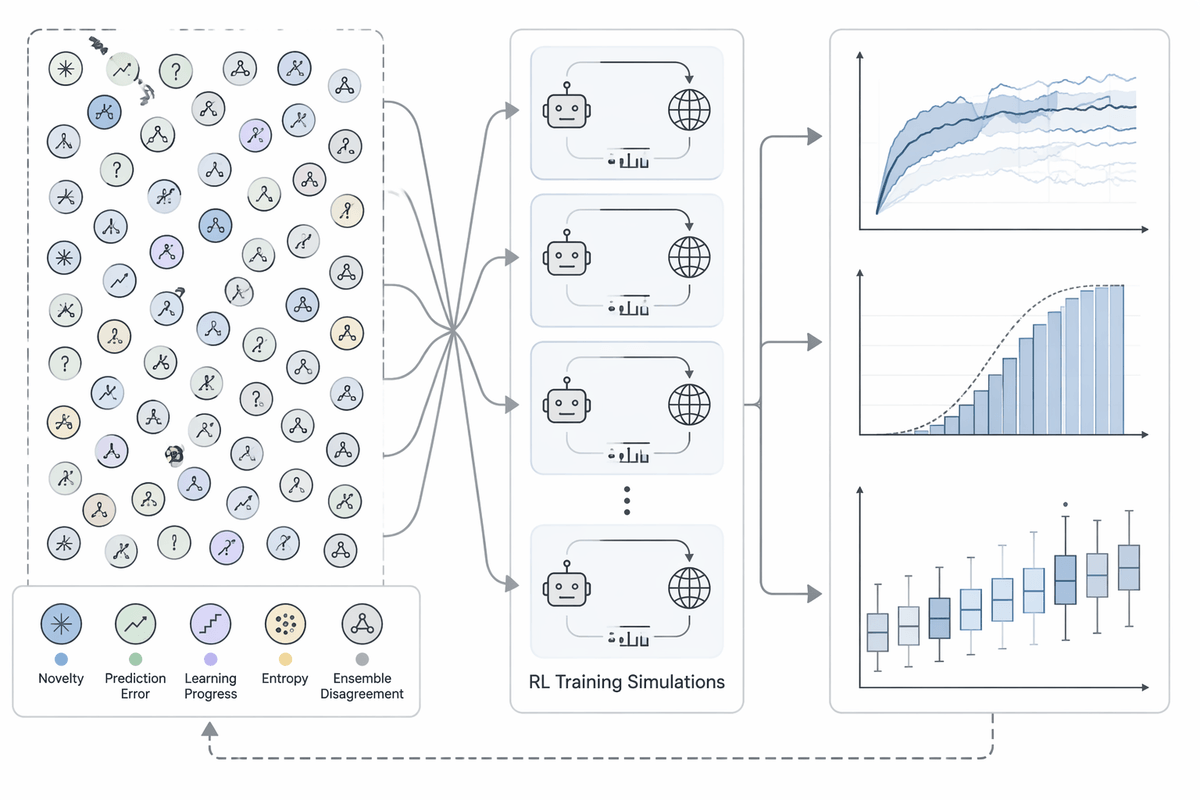
In practice, “automatically discovering” a curiosity algorithm usually means you stop hand-designing the intrinsic reward and instead run a search process that proposes and tests many candidates. A candidate might be a small formula that mixes ingredients you already know—prediction error, state novelty, learning progress, disagreement between models, entropy bonuses—plus choices like normalization, time discounting, and clipping. You evaluate each candidate by training agents and measuring outcomes like how often they reach external reward, how stable learning is, and how sensitive performance is to hyperparameters.
The important nuance is that the discovery system is still optimizing for a benchmark you chose. If it finds a “new” curiosity signal, it may be new only in the sense that humans hadn’t tried that exact combination under those exact training settings. And the search can be expensive: you might spend thousands of GPU hours to find a rule that helps in a sparse-reward maze but doesn’t transfer to your robot, your simulator, or your safety constraints without more tuning.
What to look for in the evidence, beyond headline metrics
You’ve probably seen results framed as “X% higher score” or “solves Y tasks.” The more telling evidence is about behavior and robustness. Does the agent reach reward sooner in wall-clock time, or only after far more compute? Do learning curves look smooth across seeds, or do they show rare lucky runs? If the method is sold as reducing tuning, look for sensitivity studies: do reasonable changes in intrinsic-reward scale, normalization, or model size break it, or does it hold up?
Generalization is the other tell. If an automatically discovered reward is genuinely useful, it should help across multiple sparse-reward environments, not just the one it was searched on, and it should still help when observations change (different textures, camera angles, dynamics). Also check failure modes: does it “explore” by farming stochasticity, looping in novelty traps, or drifting from the task unless heavily constrained? If the paper doesn’t show those diagnostics, the headline number is doing too much work.
Trade-offs that decide whether it helps your project
In a product setting, the first trade-off is simple: do you need more environment experience, or less? A curiosity signal can reduce the number of real “useful” episodes needed to stumble into reward, but it often increases per-step compute by adding extra models (predictors, ensembles, embedding networks) and extra bookkeeping. If you’re already bottlenecked on simulation throughput or robot time, that’s attractive; if you’re bottlenecked on GPUs or training instability, it can be a net loss.
Stability and controllability matter as much as raw score. Intrinsic rewards create a second objective whose scale drifts during training, so you may regain the tuning burden you hoped to avoid—weights, schedules, normalization, and safety constraints to prevent novelty farming. The other practical question is transfer: an algorithm “discovered” on Atari-style inputs or a specific maze distribution may not survive changes in sensors, dynamics, or reward definitions without re-running the search, which can be too costly to justify outside exploration-heavy domains.
Where this trend could go next (and what to be wary of)

You can expect “discovered curiosity” to drift toward larger search spaces and tighter coupling with the agent’s representation learning. Instead of searching over a few familiar ingredients, teams will search over whole learned reward models that look at memory, prediction uncertainty, and skill progress, then adapt the intrinsic signal over training. If it works, the win is less about a single benchmark score and more about reliable exploration across different task variations without days of manual reward shaping.
If the discovery loop needs thousands of full RL trainings, it may only be practical for big labs and may quietly overfit to whatever suite the search used. Another worry is misalignment at the exploration level: the agent can learn to maximize “interestingness” in ways that waste time, exploit randomness, or create unsafe behaviors in robotics unless you add constraints that reintroduce tuning and engineering overhead.
A practical way to stay grounded while the field moves fast
If you’re deciding whether “automatically discovered curiosity” matters for your work, treat it like any other optimization: demand a clear accounting of what it costs and what it replaces. Ask for wall-clock comparisons (not just environment steps), variance across seeds, and evidence that the discovered signal wasn’t effectively benchmark-specific reward shaping. In your own experiments, start with a fixed compute budget and a simple baseline (no intrinsic reward, then a classic method) before trying a discovered one, and log behavior videos—not just scores—to catch novelty traps early. If it needs re-running search per domain, budget for that up front.