Why “privacy” is hard when data still needs to work
“Make it private” sounds simple until the data still has to do a job: power dashboards, train models, personalize experiences, or satisfy auditors. The same fields that make analysis useful—timestamps, locations, free-text notes, rare events—also make people easier to single out when combined. Even when obvious identifiers are removed, linkability creeps in through joins, small segments, and repeated queries over time.
That tension creates practical trade-offs teams can’t avoid. Stronger privacy usually means less detail, slower access, or higher compute and governance cost. Meanwhile, product needs push toward granularity and speed, and compliance needs push toward traceability and controls. The hard part is not choosing “privacy” in principle; it’s choosing what guarantees you can actually deliver without breaking the work the data is meant to enable.
Start with the data journey and realistic threat model

Picture a single customer event: it’s captured in an app, logged by an SDK, shipped to a warehouse, joined to CRM records, exported to a vendor, and later pulled into a notebook for ad hoc analysis. Privacy risk changes at each hop. The right model depends on where the data travels, who can touch it, how long it persists, and what other datasets it can be linked with.
A realistic threat model is less “an attacker steals everything” and more specific: an analyst over-permissions themselves, a vendor keeps copies longer than promised, a dashboard reveals small segments, or repeated queries let someone infer an individual. Define adversaries (internal, partners, public), their access level, and what “harm” means (re-identification, attribute inference, policy violation).
This is also where constraints show up: production latency, limited engineering time, contractual obligations, and audit requirements. A strong guarantee that requires heavy compute or rigid workflows may be defensible on paper and still fail in day-to-day use.
The main privacy models teams actually use in practice
Most teams end up combining a few familiar models rather than betting on a single “silver bullet.” One bucket is data transformation: remove direct identifiers, generalize or suppress high-risk fields, and use pseudonyms so systems can still join records. This is the workhorse for analytics exports and vendor sharing, but it relies on assumptions about what else can be linked and how carefully the data is handled.
Another bucket is controlling who can see what: role-based access, purpose-based approvals, row/column masking, and tight logging. This doesn’t “sanitize” the data; it limits exposure and creates accountability, which is often what auditors and incident response actually need. The practical constraint is operational: permissions drift, exceptions pile up, and reviews take time.
A third bucket changes what leaves the system: aggregate-only reporting, query limits, and privacy-preserving statistics (often via differential privacy) to reduce what can be inferred about an individual. A fourth bucket changes where computation happens: federated analysis, secure enclaves, or MPC so parties get results without pooling raw data. These tend to cost more in engineering and performance, but can unlock use cases partners won’t accept otherwise.
Differential privacy: strong guarantees, tricky knobs and tradeoffs
Teams often run into differential privacy when someone asks for “safe aggregates” that can survive being published, shared with a broad internal audience, or queried repeatedly. The core idea is simple: add carefully calibrated randomness so the presence or absence of any one person has a limited impact on the output. That gives a guarantee that is less dependent on secrecy or on guessing what other datasets might get linked later.
The privacy budget (often expressed as epsilon) is a finite resource that gets spent across releases, dashboards, and repeated queries. Spend too little and results get noisy, especially for small segments or long-tail metrics. Spend too much and the guarantee weakens in ways that are difficult to explain to non-experts. Composition also matters: ten “mostly safe” queries can add up to one unsafe system.
DP also tends to reshape product requirements. You may need larger minimum cohort sizes, fewer slice-and-dice dimensions, and a decision about what accuracy is acceptable for business actions. There’s real cost too: implementing DP correctly requires careful accounting, guardrails to prevent budget bypass, and governance to avoid shipping “DP” outputs that are still joinable to raw data.
Anonymization and pseudonymization: where they help—and fail
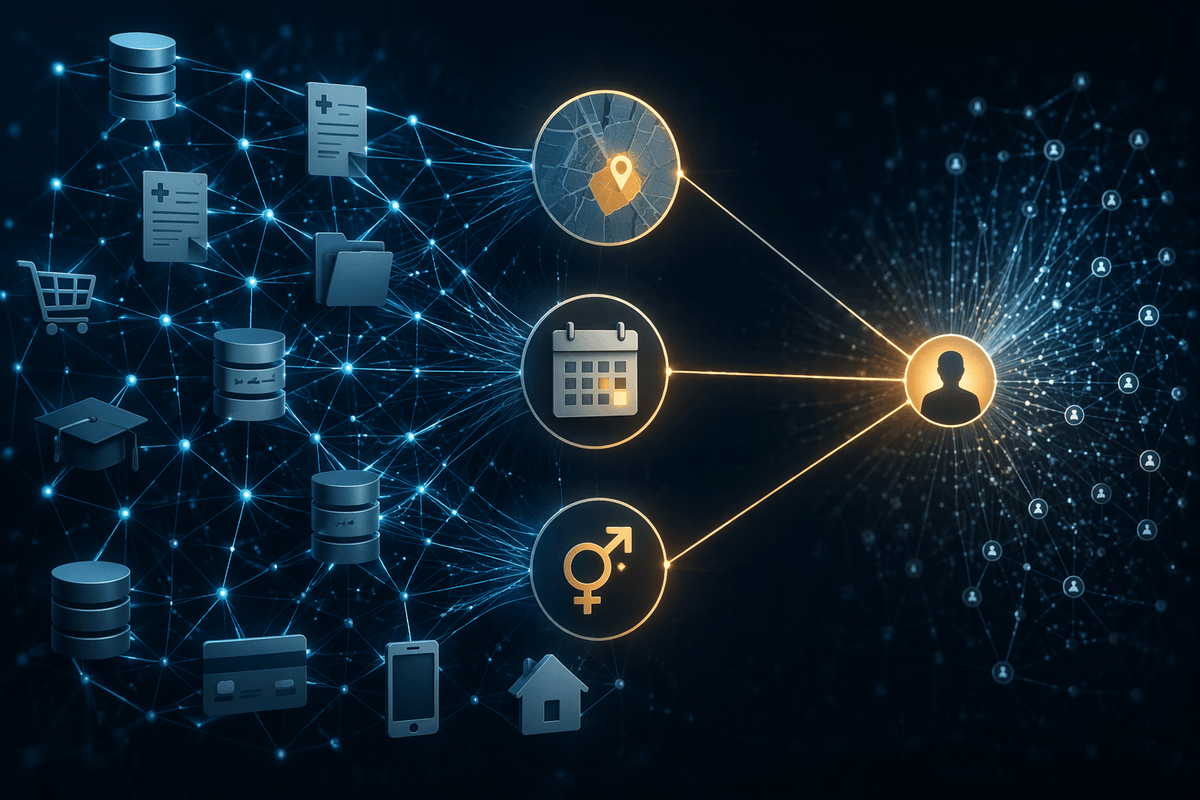
Most teams reach for anonymization first: drop names and emails, bucket ages, truncate timestamps, hash an ID, and call it “de-identified.” That can be useful for routine analytics sharing because it reduces accidental exposure and lets systems keep joins working. Pseudonymization in particular is practical when you still need user-level linking across events, sessions, or devices without handing partners direct identifiers.
The failure mode is that “not directly identifying” is not the same as “not identifiable.” Linkability comes back through quasi-identifiers (ZIP+birthdate+gender), rare behaviors, or stable pseudonyms that act like a tracking key. Hashing is often reversible in practice via dictionary attacks or matching against another dataset, and internal teams frequently keep a lookup table for recontact—turning the export into “protected” data, not anonymous data.
A good rule is to treat anonymization as a risk-reduction technique, not a publish-safe guarantee. If the data will be combined with outside sources, queried broadly, or used to make decisions about individuals, you’ll need cohort thresholds, strict access controls, or a stronger model than “we removed identifiers.”
When you need control, not noise: access, enclaves, and MPC
Sometimes the problem isn’t that aggregates might leak; it’s that someone needs to run user-level work—debugging a funnel, building a feature store, or investigating fraud—without letting raw records sprawl. In those cases, “add noise” doesn’t solve the real risk. The safer move is to constrain exposure: least-privilege roles, time-bound access, break-glass workflows, and row/column policies that follow the data into warehouses and BI tools. Logs and approvals sound bureaucratic, but they’re often the difference between a controlled analysis environment and an untraceable set of extracts.
When partners won’t send data, or regulators care where computation happens, secure enclaves and similar “clean room” patterns can help. Data stays in a controlled environment; analysts bring code, not copies. The constraint is practical: enclave-friendly workflows are slower, harder to debug, and can block common tools like interactive notebooks or arbitrary package installs.
MPC goes further by letting multiple parties compute a joint result without revealing their inputs to each other. It can unlock measurements like overlap, attribution, or risk scoring across organizations, but it’s expensive in engineering effort and compute, and it tends to limit the kinds of queries you can run to what’s been carefully designed and tested.
Choosing the right model: match guarantees to product constraints
A familiar fork shows up when someone asks, “Can we share this dataset?” and what they really mean is “Can more people use it, faster.” If the output will be broadly visible, repeatedly queried, or sent outside the company, treat that as a publish-like setting and favor aggregate-only approaches with cohort thresholds—often differential privacy when you need defensible, repeatable guarantees. If the work requires user-level joins, debugging, or feature building, accept that transformation alone won’t carry the risk; prioritize strong access controls, tight logging, and environments that prevent copy-out.
Match the model to the decision the data will drive. If results change what happens to a specific person (eligibility, pricing, discipline), you need traceable governance and the ability to explain inputs—DP noise can be a poor fit, while enclaves or purpose-limited access may be. If the goal is population measurement (product health, adoption, performance), DP or carefully constrained aggregates are usually easier to defend.
DP needs budget accounting and guardrails. Clean rooms and MPC trade flexibility and speed for stronger containment. Pseudonymization is cheap and useful, but only if you’re honest that it’s “controlled data,” not anonymous data.
A workable privacy posture is layered, measurable, and maintained
In practice, a defensible posture looks like multiple controls stacked: minimize and classify data early, use pseudonyms where joins are required, constrain access and copy-out, and publish only aggregate outputs with cohort thresholds (or DP) when distribution gets broad. The goal is to make failure require multiple things to go wrong, not just one missed redaction.
Make it measurable: define concrete privacy claims (“no cohorts under 100,” “DP epsilon per dashboard per quarter,” “vendor exports expire in 30 days”), then monitor them with logs, budget accounting, and periodic re-identification or linkage testing. The cost is ongoing ops—reviews, key management, and policy drift—but without maintenance, yesterday’s “safe” dataset becomes today’s incident.